A gloomy reimagining of the classic fairy tale, Anne Sexton’s Snow White questions notions of femininity, gender, and beauty. Instead of portraying the event as a straightforward tale of good triumphing over evil, Sexton highlights the pressures women face to maintain their youth, beauty, and subservience. Snow White is praised throughout the poem because she is referred to as “a lovely virgin” (Sexton lines 14–15), and the Queen grows fixated on continuing to be the most beautiful woman in the realm. Sexton challenges readers to consider the lessons fairy tales impart about what it means to be a woman by distorting these conventional roles.
Beauty and purity are portrayed as the most desired attributes a female can have from the poem’s opening lines. Sexton characterises “the virgin” as “unsoiled” and “as white as a bonefish” before Snow White ever makes an appearance (Sexton lines 2–13). According to these descriptions, women are primarily valued by society for their physical attractiveness and purity. Readers are first introduced to Snow White as “a lovely virgin” (Sexton lines 14–15), which means they learn about her beauty before learning anything about her character. Sexton criticises the unreasonable expectations imposed on women and girls by using this inflated description.
The Queen’s jealousy also illustrates how beauty encourages women to compete with one another. As soon as the magic mirror declares that “Snow White is fairer than you,” the Queen gives the order to execute Snow White (Sexton lines 34–48). The Queen views Snow White as a danger rather than lending support to another women. This illustrates the notion that women’s worth is frequently determined by how they look rather than by their accomplishments or knowledge.
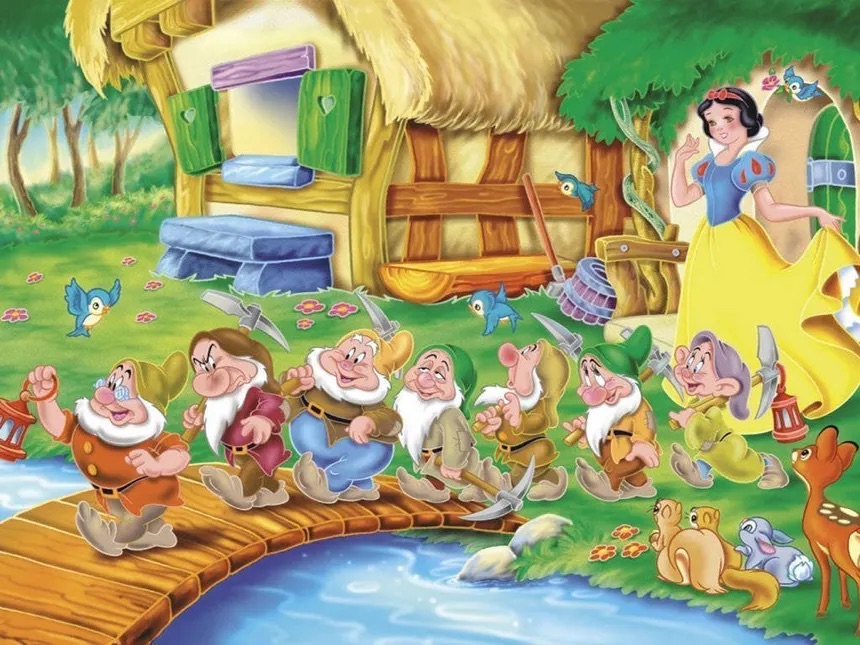
Snow White discovers the dwarfs’ home after fleeing into the forest, where she is expected to assume a conventional household position. While they work in the mines during the day, the dwarfs ask her to “stay and keep house” (Sexton lines 76–84). By portraying women as in charge of cooking, cleaning, and home maintenance while men labour outside and support others, this perpetuates old gender norms. Snow White implies that domestic work is seen as a normal responsibility for women by accepting this job without questioning it.
Additionally, the dwarfs stand for conventional notions of masculinity. They serve as Snow White’s guardians despite Sexton’s amusing description of them as ‘little hot dogs’ (line 69). In an effort to protect her from harm, they continuously caution her, saying, “Beware of your stepmother” (lines 79–80). Nevertheless, Snow White regularly lets the disguised Queen in despite these cautions (lines 91, 107, 117–120). Sexton even refers to her as “the dumb bunny” (line 117), criticising her lack of autonomy with sarcasm and comedy. Snow White promotes the stereotype of women as innocent yet defenceless by being passive and susceptible to manipulation rather than making thoughtful decisions for herself.
The story concludes with a prince saving the heroine, just like many classic fairy tales. “Snow White became the prince’s bride” (line 147) following the removal of the poisoned apple from Snow White’s throat. Marriage is more important to her happy ending than her own deeds or accomplishments. By implying that Snow White still acts like a doll, “rolling her china-blue doll eyes open and shut” (lines 161–164), Sexton parodies this well-known fairy-tale conclusion. This picture suggests that even though she is now queen, she is still constrained by standards of beauty and femininity. Readers are prompted by the conclusion to consider if marriage actually signifies freedom for female characters.
According to Jack Zipes, fairy tales frequently mirror the ideals and beliefs of the civilisations in which they originated. This viewpoint is reinforced by Sexton’s retelling, which shows how traditional traditions instill in girls a valuing of domesticity, obedience, and beauty. Sexton exaggerates these concepts to show how harmful and impractical they may be, rather than just restating the Grimm fairy tale. Her rendition challenges viewers to consider the lessons concealed in well-known children’s tales.
Additionally, Jacqueline Rose contends that rather than reflecting children’s experiences, children’s literature frequently mirrors adult conceptions of childhood. This is clear throughout Sexton’s poem, as Snow White is virtually solely evaluated according to adult standards of behaviour, innocence, and beauty. Snow White rarely has control over her own destiny; instead, the grownups in the tale determine what makes her desirable. Sexton challenges contemporary readers to consider whether children’s literature should continue to uphold these ideals by outlining these demands in such a striking way.
Compared to Sexton’s version, the heroine in many modern Snow White adaptations is seen as being more self-reliant and self-assured. Instead of waiting to be saved, modern retellings frequently depict her making choices, resolving issues, and defending herself. By contrasting these more recent renditions with Sexton’s poem, one can see how ideas toward gender equality are evolving and how children’s literature changes in tandem with society.
All things considered, Snow White by Anne Sexton is far more than just a retelling of a well-known fairy story. She challenges conventional notions of femininity, attractiveness, and gender norms through satire, irony, and striking images. Sexton challenges readers to consider the lessons that fairy tales have traditionally imparted to children by portraying Snow White as a lovely but submissive heroine and revealing the Queen’s fixation with appearance. Because it asks readers to consider how stories influence our perceptions of gender and identity, her poetry is still important today.
For more information about Jack Zipes’ work on fairy tales and children’s literature, visit the University of Chicago Press author page for Jack Zipes.
 billiereads