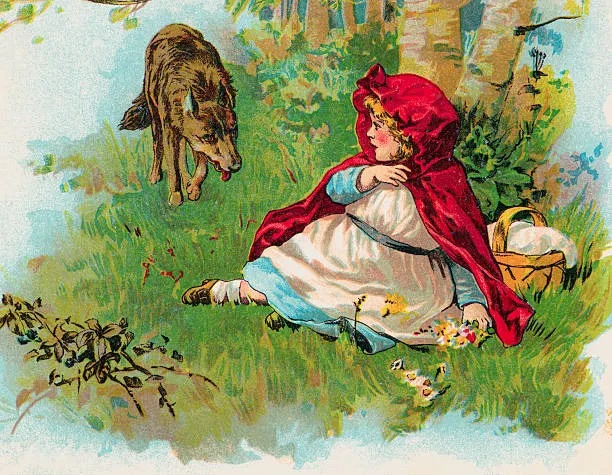
The Girl Who Was Told to Obey, Gender Roles in Little Red Riding Hood.
Most individuals associate Little Red Riding Hood with a young girl wearing a Red cloak, a frightening wolf, and a dramatic rescue. It may seem like a straightforward fairy tale, but it also imparts lessons to kids about appropriate behaviour for girls. Little Red Riding Hood is only one of many fairy tales that have been utilised for generations to impart social lessons. The fable presents traditional expectations of girls by promoting obedience, innocence, and caution rather than just cautioning kids against strangers. Young readers’ perceptions of gender and behaviour are influenced by these messages.
Little Red Riding Hood is portrayed as a subservient child right from the start of the tale. Her mother gives her explicit instructions to follow the trail, bring food to her grandma, and keep away from distractions before she leaves the house (Zipes, 1993). These guidelines make it clear that adults want females to pay attention, act appropriately, and abide by the rules. Little Red Riding Hood is not encouraged to be daring or self-reliant, in contrast to many male fairy tale protagonists. Rather, she is supposed to be cautious and considerate.
Nevertheless, Little Red Riding Hood breaks away from the road after stopping to talk to the wolf in spite of these directives. This choice turns into the story’s crucial moment. The wolf arrives at the grandmother’s home before her, taking advantage of her generosity and naiveté. Thus, the narrative implies that girls who disobey authority put themselves in risk. The story also highlights Little Red Riding Hood’s error rather than just concentrating on the wolf’s deeds. By doing this, the narrative assigns the young girl some accountability.
Traditional ideas of femininity are reflected in this message. Although girls are frequently expected to be kind, trustworthy, and respectful, these traits can also make them vulnerable. Because she is unaware of the threat the wolf poses, Little Red Riding Hood converses with him honestly. This proves her innocence, but it also perpetuates the notion that girls need to continuously defend themselves. Therefore, rather than expecting hazardous people to behave differently, young readers could learn that it is their job to avoid risk.
According to Jack Zipes, fairy tales frequently mirror the principles and viewpoints of the civilisations in which they were recounted and changed. Fairy tales convey social norms and cultural expectations rather than being merely entertaining (Zipes, 1993). One of these assumptions in Little Red Riding Hood is that girls ought to be submissive. The narrative teaches kids what is socially acceptable behaviour by rewarding compliance and punishing noncompliance.
Additionally, Jacqueline Rose contends that children’s literature is never totally innocent since novels about childhood and conduct are written by adults. Rose claims that rather than merely reflecting children’s experiences, children’s books frequently influence how adults want kids to think. This concept can be extended to Little Red Riding Hood, a tale that teaches young readers to accept conventional norms without challenging them. Rather of letting Little Red Riding Hood make wise decisions on his own, the tale emphasises that safety comes from obeying adults. Fairy tales, according to Jack Zipes, are more than just amusing tales, they also represent the societal ideals of the societies in which they originated (Zipes).
These statements still have an impact on readers today, even though they may have mirrored past concerns. Girls are still frequently given more safety advice than boys. Daughters are frequently reminded by their parents to stick with friends, avoid strangers, and exercise caution when out on their own. These discussions are crucial, but they also show that expectations for girls’ behaviour are still different from those for boys. It is clear from reading Little Red Riding Hood now that these concepts have been around for generations.
These traditional gender roles are occasionally challenged in modern versions of the tale. In other versions, Little Red Riding Hood is shown as fearless, confident, and able to defend herself instead of waiting to be saved. These renditions inspire kids to view girls as self-reliant and resilient while reflecting shifting views on gender equality. Fairy stories are dynamic and change with society, as evidenced by the comparison of traditional and contemporary versions.
All things considered, Little Red Riding Hood is far more than just a tale about a girl and a wolf. It educates kids about gender norms, danger, and adherence to them. The narrative presents fragility as a feminine trait while encouraging females to be cautious and obedient through Little Red Riding Hood’s deeds and their results. These concepts are still relevant now because they continue to impact conversations about gender and youth, even though they were prevalent when many fairy tales were originally created. By delving further into the narrative, readers can see that fairy tales influence children’s perceptions of the world in addition to providing entertainment.all around them.
Modern adaptations of Little Red Riding Hood continue to question gender norms and inspire readers to reconsider the narrative. The British Library’s collection of fairy tales is a good place to start if you want to discover more about the origins of fairy tales and investigate various retellings of Little Red Riding Hood.
 billiereads